ASB EXIM ENTERPRISER
- sales.asbexim@gmail.com
ASB EXIM ENTERPRISER

Call us now :
+91 9689967369
Email us now :
ajape@rediffmail.com
+91 9689967369
ajape@asbeximenterpriser.co
sales@asbeximenterpriser.co

In the world of machining, precision and performance go hand in hand—and nothing plays a more vital role in that relationship than milling cutter tools. Whether you’re a CNC machinist, a tool room operator, or a manufacturing engineer, understanding the different milling cutter types and their applications can drastically improve both efficiency and accuracy.
his guide is your go-to resource for everything you need to know about milling cutters—their types, uses, features, and how to pick the right one for your job.
Milling cutters are rotary tools used in CNC (Computer Numerical Control) milling machines and manual mills to remove material from a workpiece. These tools are fitted with sharp cutting edges and are used to shape metals, plastics, wood, and other materials into complex forms.
Milling cutters come in a wide variety of shapes, sizes, and materials. Each is designed for a specific task or material, whether it’s high-speed cutting, roughing, finishing, or contouring.
Choosing the right milling cutter tools can be the difference between a smooth, efficient process and a tool-wrecking disaster. The right cutter:
Let’s dive into the major milling cutter types and their most common applications.
Understanding the most common milling cutter types helps you match the right tool with the job. Here are the primary categories:
1. End Mills
One of the most widely used milling cutter tools, end mills come in various styles:
Use Case: General-purpose cutting, die and Mold work, slotting, and profiling.
2. Face Mills
Face mills are designed for high-efficiency surface cutting. They have multiple cutting inserts mounted on a large, flat body.
Use Case: Facing large flat surfaces with excellent finish and rapid material removal.
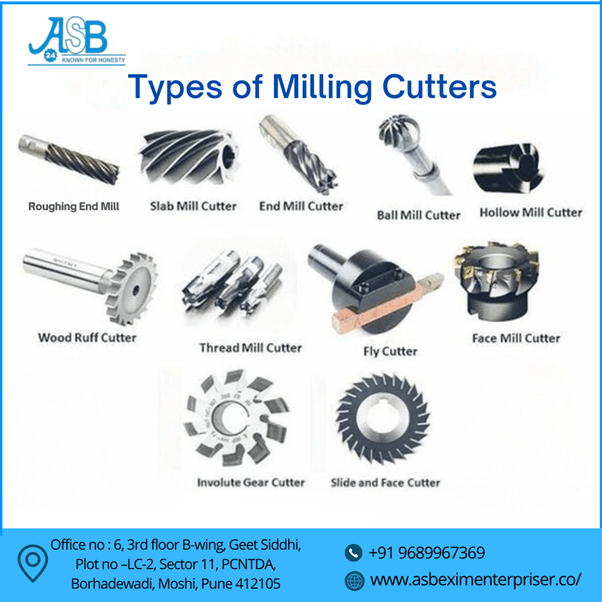
3. Shell Mills
Shell mills are similar to face mills but are used with an Arbor or a tool holder. They are suitable for heavy cutting applications.
Use Case: High-volume production, roughing large surfaces, or machining cast iron.
4. Slab Mills
These are large-diameter cutters used primarily in horizontal milling machines. Their wide cutting surface allows them to remove large amounts of material quickly.
Use Case: Machining wide and flat surfaces in heavy-duty applications.
5. Fly Cutters
Fly cutters use a single-point cutting tool mounted in a rotating head. They’re less expensive but slower than multi-insert face mills.
Use Case: Producing a fine surface finish on flat surfaces.
6. Side and Face Cutters
These cutters are designed to mill slots and grooves. They have teeth on both the periphery and the sides.
Use Case: Cutting deep grooves or slots where extra cutting depth is needed.
7. T-Slot Cutters
These are specialized tools for machining T-shaped slots in workpieces.
Use Case: Often used in fixture building and table slotting.
8. Gear Cutters
These are used to cut gear teeth profiles and are available in several profiles based on gear standards.
Use Case: Gear manufacturing in automotive and heavy machinery industries.
The performance of milling cutter tools isn’t just about shape—it also depends heavily on what they’re made of.
Common Materials:
Popular Coatings:
Choosing the best milling cutter tools isn’t just about shape and material—several other features can impact performance:
1. Number of Flutes
2. Helix Angle
3. Coating Compatibility
Match your coating to your material—this can double (or triple) tool life.
4. Shank Type
Choose between straight shank, Weldon shank, or threaded depending on your tool holder system.
Using milling cutter tools efficiently involves more than just tool selection. Follow these best practices:
Milling cutters are used across multiple industries, including:
Choosing the right milling cutter tools can significantly elevate your CNC machining capabilities. From understanding different milling cutter types to selecting the best materials and coatings, each decision plays a part in enhancing performance, accuracy, and cost-efficiency.
Whether you’re upgrading your tool library or troubleshooting poor finishes and tool wear, this guide arms you with the knowledge to choose smart and machine better.
So, the next time you’re planning a job, remember: better cutters lead to better outcomes. Invest wisely, machine precisely, and watch your productivity soar.