ASB EXIM ENTERPRISER
- sales.asbexim@gmail.com

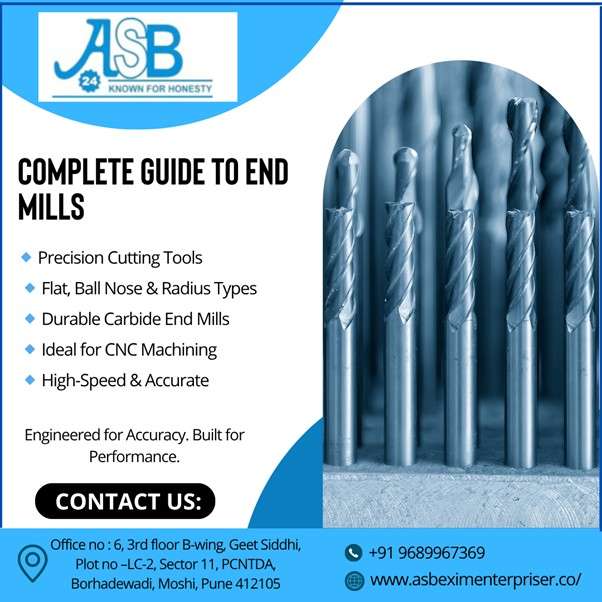
End mills are fundamental cutting tools in the manufacturing industry. Designed for use in vertical milling machines and CNC machining centers, they perform a wide range of material removal processes with accuracy and speed. Used for profiling, slotting, contouring, and plunging, these versatile tools come in many styles and configurations. Among the various options available today, carbide end mills stand out for their durability and precision.
End mills are rotary cutting tools with one or more flutes, used to remove material from the surface of a workpiece. Unlike traditional drill bits, which only cut axially, end mills can cut both axially and radially. This allows them to perform a broader variety of milling tasks, including side milling, face milling, and slotting.
End mills are used across industries such as automotive, aerospace, die and Mold, and general engineering. They are suitable for both roughing and finishing operations depending on the design and material used.
Selecting the right type of end mill is crucial for achieving optimal surface finish, dimensional accuracy, and machining efficiency. Here are the main types:
1. Square End Mills
These have a flat cutting surface and are ideal for sharp corners and pocket milling. They are used for general-purpose milling where the creation of 90-degree angles is required.
2. Ball Nose End Mills
Featuring a rounded tip, ball nose end mills are used in contour milling, surface finishing, and 3D profiling. They are especially useful in die and Mold industries.
3. Corner Radius End Mills
These combine the features of square and ball nose end mills, offering enhanced strength and reduced wear. The slightly rounded corners increase tool life and provide a better surface finish.
4. Roughing End Mills
Designed for high-volume material removal, roughing end mills have serrated cutting edges. These edges break up the chips and reduce cutting forces, making them suitable for heavy-duty milling.
5. Finishing End Mills
Used after roughing, these tools help achieve tight tolerances and excellent surface finishes.
Carbide end mills are made from a composite material containing tungsten carbide and cobalt. This combination offers exceptional hardness and heat resistance, making carbide end mills ideal for high-speed applications and machining tough materials such as stainless steel, cast iron, and titanium.
Carbide end mills are especially useful in industries where precision and tool longevity are non-negotiable. Their ability to maintain sharp cutting edges over extended periods increases productivity while reducing downtime.
Several factors influence the performance and efficiency of end mills:
Higher helix angles provide smoother cutting and better chip evacuation, while lower angles offer more strength for tougher materials.
End mills often come with specialized coatings like TiN (Titanium Nitride), TiAlN (Titanium Aluminium Nitride), and AlCrN (Aluminium Chromium Nitride). These coatings enhance wear resistance, reduce friction, and improve heat dissipation.
Shanks can be straight or tapered, depending on the specific requirement of the tool holder and application.
End mills are employed in a wide variety of machining operations:
Material selection is crucial for ensuring tool performance and lifespan. Here’s a comparison:
To get the most out of your end mills:
Regular inspection and resharpening can also significantly extend tool life.
Final Thoughts
Whether you’re machining complex aerospace components or general industrial parts, choosing the right end mill—especially high-performance tools like carbide end mills—can significantly impact productivity, surface finish, and cost-effectiveness. Understanding the differences in type, material, and geometry will help you make informed decisions that lead to better machining outcomes.
For professionals aiming for precision and performance, investing in quality end mills is not just a choice—it’s a necessity.